An official website of the United States government
A .mil website belongs to an official U.S. Department of Defense organization in the United States.
A lock (lock ) or https:// means you’ve safely connected to the .mil website. Share sensitive information only on official, secure websites.

OUR MISSION

The Wounded Warrior Regiment provides leadership and ensures compliance with laws and Department of Defense (DoD) regulations related to the support, recovery, and non-medical care of combat and non-combat wounded, ill, and injured (WII) Marines, Sailors attached to Marine units, and their family members in order to maximize their recovery as they return to duty or transition to civilian life.


Who we Serve: Our Population

Wounded Warrior Regiment is committed to the recovery and success of Marines whether they are assigned to the regiment, remain with a parent unit, or have already transitioned to civilian life. We keep faith with Marines through our various types of support, ranging from section leaders and recovery care coordinators supporting active duty Marines to the District Injured Support Coordinators/Field Support Representatives and call center representatives assisting reserve and veteran Marines. WWR also offers the support of Clinical Care Advocates (CCA), licensed clinical social workers, registered nurses, nurse practitioners, or physician assistants who are located at WWR and Battalions and work closely with WII Marines and medical staff to help determine the most appropriate resources for medical and psychological issues. CCA’s are available to assist throughout all levels of support.


Locations

The regimental headquarters, located in Quantico, Virginia, commands the operation of two Wounded Warrior Battalions and multiple detachments in locations around the globe, including major military treatment facilities and Department of Veterans Affairs Polytrauma Rehabilitation Centers. We have Marine leaders standing shoulder-to-shoulder with our warriors and families. Regardless of location, our services are available to the total force – active duty, reserve, and veteran Marines and their families.
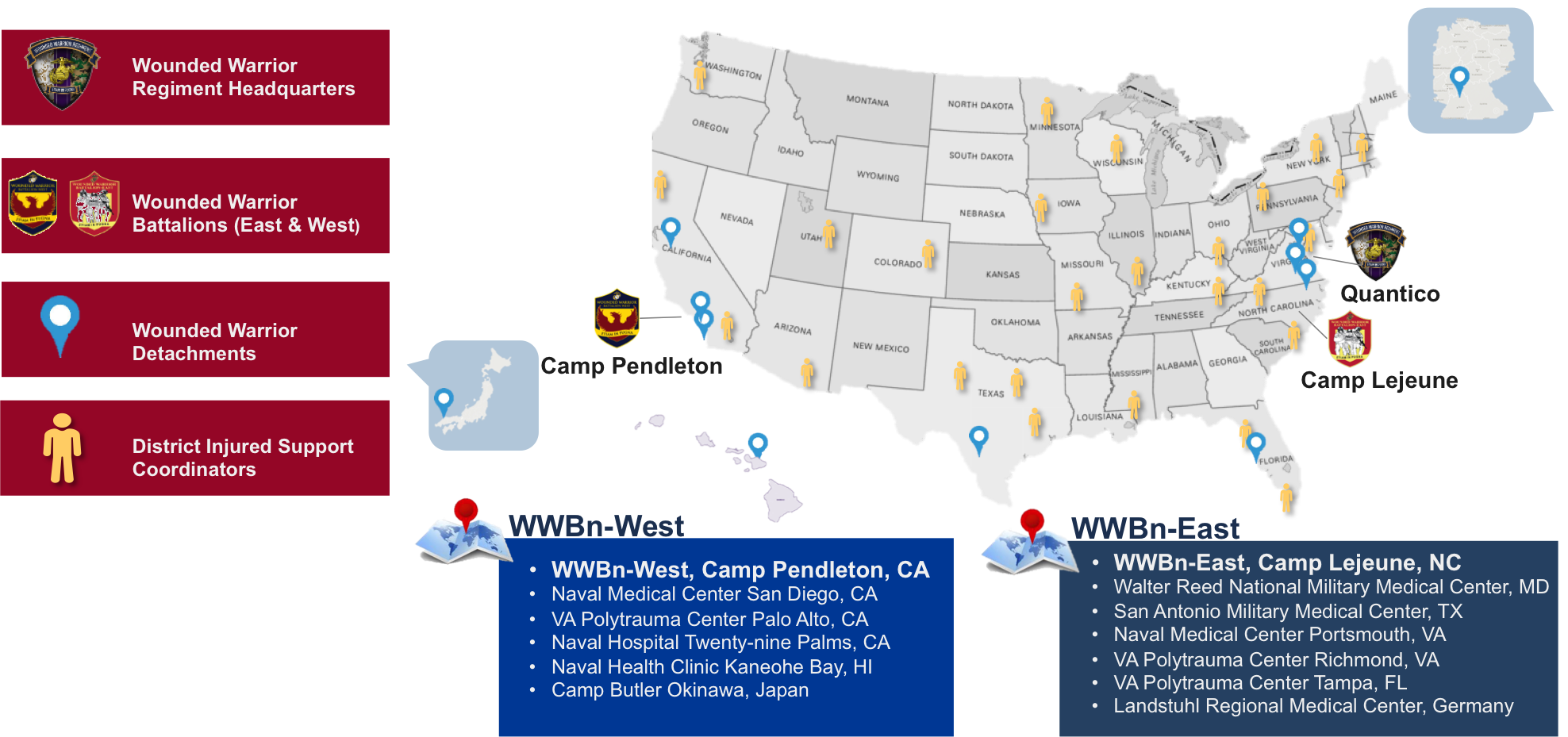


The Wounded Warrior Regiment achieves its mission through two battalions. Each Wounded Warrior Regiment Battalion (WWBn) also has a contact center. Contact Center Representatives monitor a Marine's recovery within their area of responsibility and provide information on programs and resources. Click the buttons below to learn more about each battalion:


Your Marine

If you have or know a Marine who is on limited duty, has recently fallen ill or incurred a wound or injury, or is being referred in the Integrated Disability Evaluation System (IDES), the Wounded Warrior Regiment has the expertise to assist you in determining how best to support your Marine. The Leaders’ Guide provides information on when to consider referral to WWR, major programs of the WWR, transition resources and other helpful resources.


Assignment

The Commandant of the Marine Corps expressed intent that WII Marines should remain assigned to their parent units, as long as their medical conditions allow and their units can support them. When recovery needs are too great, Marines may be assigned to a Wounded Warrior Regiment element in order to focus completely on recovering and returning to full and unrestricted duty or transitioning to civilian life.

Assignment to the WWR is typically considered if the Marine:

  • Has injuries that will require more than 90 days of medical treatment or rehabilitation.

  • Has three or more appointments of complex nature per week.

  • Has transportation requirements to appointments that the parent command cannot support.

  • Is unable to serve a function in the parent command due to their injuries or illnesses.

Assignment to the WWR is typically not considered if:

  • A Line of Duty or misconduct investigation is required and not yet complete. 

  • There are pending military or civilian legal issues. 

  • The Marine is already at the Physical Evaluation Board (PEB) step in the IDES process.

  • The Marine requires a level of monitoring or observation which cannot be provided by the WWR (24-hour watch, extreme psychological or behavioral conditions, etc.)